Trusted digital infrastructure for U.S. chipmaking.
Created to address the growing complexity, security, and operational demands of modern semiconductor manufacturing.

Semiconductor manufacturing has become too complex to operate without AI and connected operational intelligence.
Modern semiconductor fabrication requires extraordinary precision, with thousands of coordinated process steps, nanometer-scale tolerances, and equipment from dozens of vendors operating in real time. The complexity of a modern fab has outgrown the tools available to manage it. No engineering team can monitor and optimize this system without AI. No AI can function without the data infrastructure to connect it.
The U.S. Semiconductor Gap: Demand vs. Domestic Manufacturing
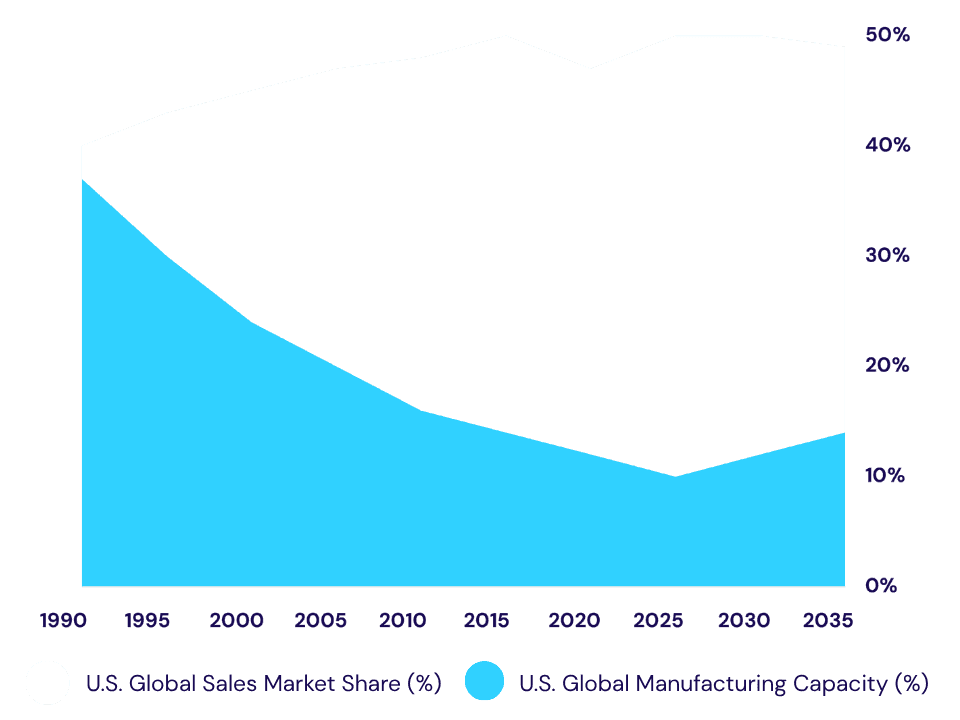
The demand for chips is at an all-time high.
The United States consumes more than 50% of global semiconductor production, yet manufactures only 12% of the world’s supply. That gap is not simply a trade imbalance. It is a national security vulnerability, a supply chain constraint, and a direct limit on the industries that depend on chip availability: defense, automotive, AI infrastructure, and advanced communications.
The CHIPS and Science Act has committed over $50 billion to rebuilding domestic manufacturing capacity. But capacity investment does not automatically yield efficiency. The fabs being built today need to operate at the edge of what is technically possible: faster, at higher yield, with less downtime. That is the operating challenge that AI-enabled digital twin infrastructure is built to address.
Built from inside the industry.
TwinLabs is purpose-built, not repurposed.
TwinLabs was not conceived in a boardroom. The team behind it came from the environments that define complex, safety-critical industries: nuclear engineering, manufacturing cybersecurity, semiconductor fabrication, and the public-private partnerships where government investment meets factory-floor reality. In each domain, the pattern was the same. Powerful modeling capabilities existed, but no shared environment existed to build, validate, and deploy them at scale. In semiconductor manufacturing, that gap had become a strategic liability.
TwinLabs was built to close it. The team brought direct relationships with national laboratories, fabs, equipment providers, and research institutions, and designed the platform not as outside observers theorizing about what the industry needed, but as practitioners who had already seen what was missing. The result is a platform shaped by the actual constraints, workflows, security requirements, and human realities of the environments it serves.
A data integration platform carries a national security responsibility.
Proprietary process data is the source of competitive advantage in semiconductor manufacturing. A platform that creates vulnerabilities in that data does not simply expose a company’s IP; it undermines the competitive position of U.S. manufacturing and, by extension, the economic and national security of the United States.
Chip independence is a national security issue. A semiconductor supply that depends on foreign production puts defense infrastructure, communications systems, and economic competitiveness at risk. Any data integration platform connecting U.S. manufacturers has a responsibility to operate at the security standard that risk demands.
TwinLabs was engineered with security as the primary design constraint. Our engineering team and advisory group were recruited from national security backgrounds. Your process data stays inside your security perimeter: TwinLabs deploys on-premises or in your private cloud, models train without moving proprietary data off-site, and no participant’s data is ever visible to another. Proprietary process data is protected by architecture, not by policy that can be changed.
Proprietary process data is never exposed: by architecture, not policy.
Built in from the first line of code, not added on as a compliance layer.
TwinLabs does not compete with its participants. Its independence from competitive interests is structural.